
White-label link building is simple to describe: a fulfillment provider builds links for your client, and you deliver the work under your agency’s name. The hard part is that your name is on every link, so you inherit every bad one. Before you resell anybody’s links, you need to be able to explain why each one belongs there, and “it’s a DR 60” isn’t an explanation.
Bradley Benner has run both sides of this. He used to buy white-label fulfillment for his own agency, then in January 2022 he launched Semantic Links, a white-label off-page service that now sells to other agencies. He told Jeremy Rivera on Unscripted SEO that it’s his highest-revenue business. He also said a lot of what agencies send him still runs on outdated playbooks, and he doesn’t hide how he feels about it:
“These agencies and so-called professionals are out there selling SEO services to unsuspecting local businesses, taking their hard-earned money and saying that I’m gonna get we’re gonna get you results, and they’re doing stuff that has been outdated for years, and then they wonder why they’re not getting their clients’ results.”
Bradley Benner, Semantic Links, on Unscripted SEO
What he checks instead turns into a short list of questions you can put to any provider, including us.
Relevance comes first, and third-party metrics come second
Bradley’s test came out of months of testing in 2021, before he built the service. His conclusion is blunt: domain metrics don’t decide whether a link is worth having.
“It’s not some stupid third party metric like DA or DR or trust flow or anything else that matters about whether a link is valuable or not. What matters is whether it’s relevant.”
Bradley Benner
He isn’t telling you to throw the metrics out. If you want to use DR or Trust Flow as a tiebreaker after you’ve confirmed a site is relevant to what it links to, he says that’s fine. Just use it second.
For you as the reseller, this changes what goes in the client report. A list of domain ratings tells the client nothing they can check. A line explaining why a link sits on a site about their industry, in their region, tells them exactly why you placed it.
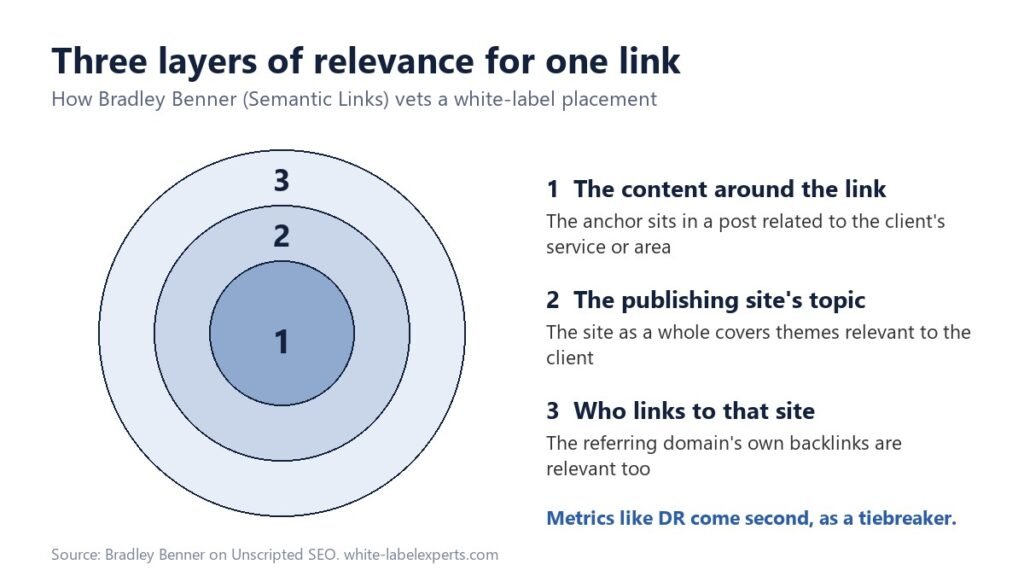
Check relevance at three levels, not one
Most agencies check whether a site is “in the niche” and stop there. Bradley checks three things for every placement:
- The content around the link: the anchor sits inside a post about something related to the client’s business or service area.
- The site’s overall topic: the blog or site publishing that post covers themes relevant to what it’s linking to.
- Who links to that site: you look at the referring domain’s own backlink profile and ask whether those links are relevant too.
In his words, “there’s basically like three layers or levels of relevance matching that can be achieved when you’re doing link building. And all of that strengthens those entity associations between the brand, products or services, and the locations or area.”
When you’re vetting a white-label vendor, ask them to walk through all three for one sample placement. If they can only talk about the first, or can only talk about metrics, you’ve learned what you need to know.
Most anchors should carry the brand
The second thing to check is the anchor text mix. Bradley told Jeremy that almost 90% of the tier-one links his team places for clients use a brand anchor or what he calls a compound anchor: the brand plus a service, the brand plus a location, or the brand plus both.
The reasoning is that his job, as he describes it, is no longer pushing metrics. It’s building associations between who the brand is, what it sells, and where it sells it. A brand-anchored link inside relevant content does that. An exact-match keyword anchor on an unrelated site doesn’t.
So if a provider’s sample report is full of exact-match anchors, ask why. It’s a fair question, and a good provider will have an answer.
A mention can do work even without the link
Jeremy asked Bradley whether AI models use links the way Google’s PageRank does. His answer was no, and it changes what counts as a deliverable:
“Links are used that’s how the the the models and the algorithms, the bots, that’s how they crawl the web. That’s how they navigate around the web.”
Bradley Benner
A link, by that reading, is a path between two things that should be related. A brand named in relevant content, linked or not, is what he calls a citation. That’s why a quote in a trade publication’s story belongs in a link-building plan, even when the journalist doesn’t link.
This is the part we do. White Label Experts places subject matter experts with the journalists covering their field. For an agency, that’s a white-label deliverable your client can’t get from a link vendor: their named expert, quoted in a story their buyers already read. We’ve written about why journalist placements beat link building campaigns. If you already have a link provider, this sits alongside them.
Six questions to ask before you resell anyone’s links
- Can you show me the content around one sample link, and explain why it relates to my client?
- What is the publishing site about overall?
- Who links to that site, and are those links relevant to it?
- What share of your anchors are brand or brand-plus-service?
- Will I see every placement before my client does, so I can stand behind it?
- If a link goes away, what happens?
A provider who answers the first three without mentioning DR is worth a second call.
If you’d rather hand off the fulfillment
White Label Experts runs alongside SEO Arcade, Jeremy Rivera’s agency. If you want the SEO fulfillment handled under your brand, SEO Arcade takes white-label and subcontract work from agencies at 25% off its standard rates on a six-month contract. That covers consulting, link building and podcast-powered link building, where the links come out of real recorded interviews. The expert placement side starts the same way it always does: tell us who your client’s expert is and what they can speak to, and we’ll tell you whether reporters are asking about it.
Either way, take those six questions to whoever builds your links now. What does your provider say when you ask why a link belongs where it is?
Quotes are verbatim from the raw Riverside transcript of Bradley Benner’s Unscripted SEO interview, trimmed only for false starts.