
This page will carry placements as they land – the query, the publication, the expert, and the date. It does not carry them yet, and we would rather say that than print a number nobody can check.
What follows instead is the mechanism: how earned coverage actually gets made, described by practitioners who do this work and said so on the record. Every quote below is verbatim from a recorded interview.
The work is earning the coverage, not announcing it
And I’m not just talking about like a normal publicist that’s a press release pusher, but the type of publicist that I am now calling myself, because I think that’s the cleanest word, is I’m a publicist, is the kind that manufactures the attention.
Justin Oberman, Unscripted SEO
What this looks like in a placement. A press release goes out and waits. The alternative is having a person with a specific, defensible opinion available at the moment a reporter is looking for one. Those produce completely different hit rates, and the second one is a staffing problem rather than a writing problem.
Most of the people doing this call it something else
There are the technical SEOs, and there are SEOs who haven’t realized yet that their job is digital PR and branding.
Zak Ali, Unscripted SEO
What this looks like in a placement. It explains why earned coverage is so badly measured inside companies. Filed under SEO, it gets judged on rankings. Filed under PR, it gets judged on volume. Neither number tells you whether the brand became easier to trust, which is the thing a quote in a real story actually buys.
The target is the mention, not the link
So I think that’s one of the things that we’re pushing is some digital PR, getting the right mentions.
Robert Spinrad, Unscripted SEO
What this looks like in a placement. A brand named by a writer who chose to name it carries weight whether or not it is hyperlinked, and it is increasingly the material AI answer engines draw on. A placement that produces a named mention and no link is not a failed placement.
A mention only counts when it can be matched to you
A citation is a published mention of usually at least two out of four data points.
Bradley Benner, Unscripted SEO
What this looks like in a placement. This is the threshold we will report against on this page. A namecheck with no other identifying detail is not the same asset as a mention carrying the company name plus a website or a location, because only the second can be resolved to the business by a machine.
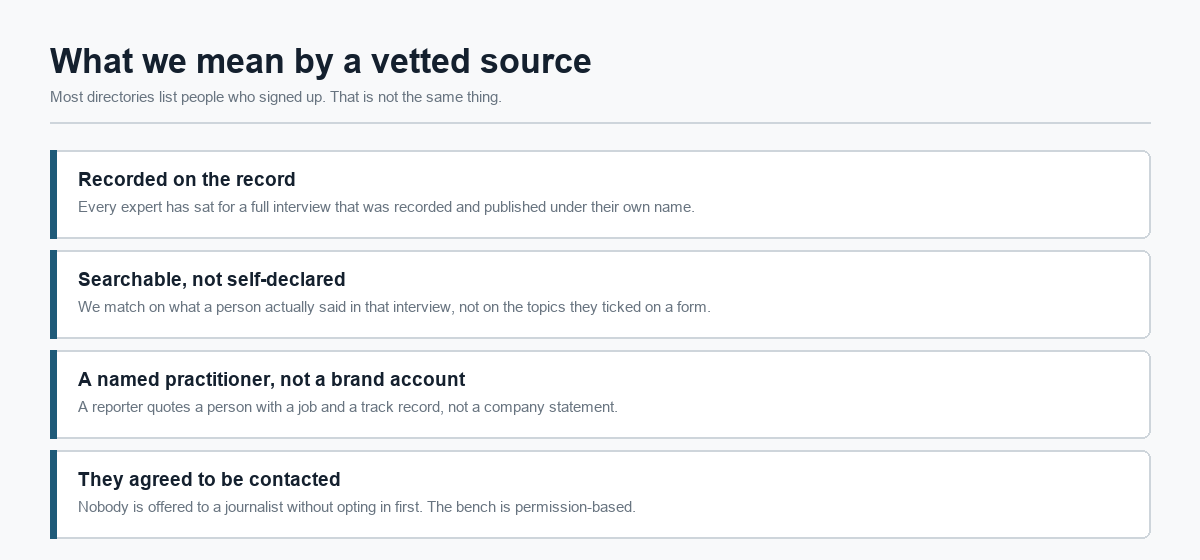
What will appear on this page
When placements land, each one gets written up with the same fields, so the page stays checkable rather than becoming a wall of logos:
- The query. What the reporter actually asked, and the deadline they gave.
- The expert. Who answered, and why they were the right person for that question.
- The outcome. Published or not published – including the ones that did not run.
- The mention. Whether it carried a link, and whether it met the two-data-point threshold above.
We will also publish the denominator. Placements are only meaningful against the number of queries seen and replies sent, and a page that shows only the wins is a page that has quietly stopped being evidence.
While this page fills up
The honest answer to “where has this worked?” today is the mechanism, not a client list. If you want to judge whether it will work for you, the useful reading is how the process runs end to end and what we do for each side. If you would rather just ask, do that.
Quotes are verbatim from recorded interviews on the Unscripted podcast network, verified against the raw transcripts on 11 September 2026, with speaker attribution confirmed for each.